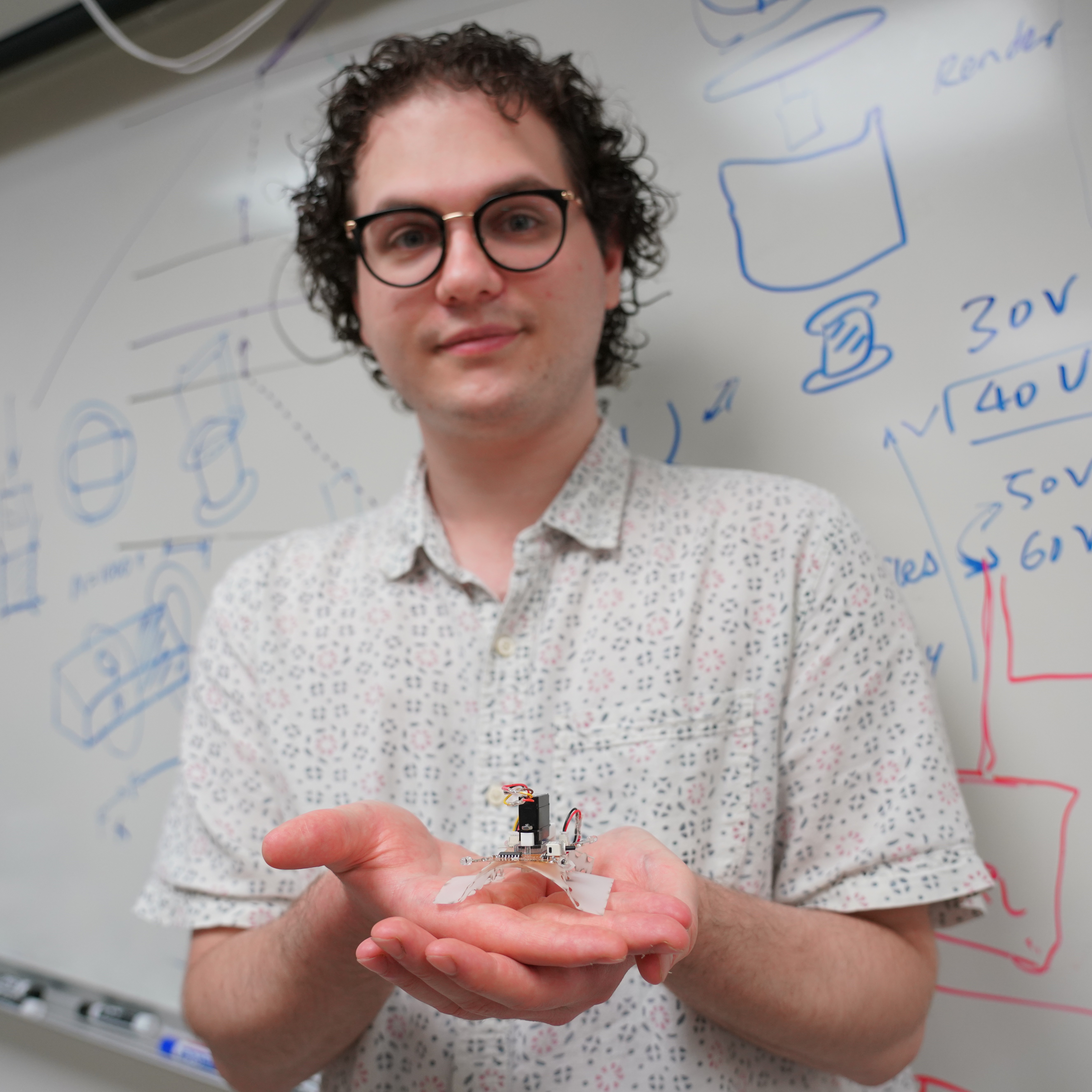
For my thesis I am developing computational tools for designing kinematic tree robots. A kinematic linkage is an assembly of joints connected together by approximately rigid structures called links - examples include arms, legs, and torsoes branching into multiple limbs. My work involves representing linkages as bent tubes shaped along curvature-constrained (3D Dubins) paths. I show that this representation leads to a design space that is fully kinematically expressive while being simplified enough for feasible design exploration by algorithms and humans. Specifically, I work on:
- Linear-time design algorithms mapping kinematic specifications to specific linkage shapes without self-intersection. These algorithms show the kinematic expressivity of the tubular design space, and more broadly prove the surprising result that it is possible to implement any sequence of axes of motion as a kinematic chain with no self-intersection in any well-defined configuration.
- Gradient-based optimization of curvature-constrained paths, used to take the results of the design algorithms and improve their compactness while preserving required non-self-intersection.
- Interactive design software for non-experts to design kinematic trees via intuitive click-and-drag arrangement of joint modules, visualize potential motions, and export fabrication files for 3D printing or origami.
- A study of STEM identity formation in a high school robot design project. As students use our interactive design software to prototype functional robots, we are interested in how feelings of customization agency over the design process, and personal ownership over the resulting designs, shape self-efficacy and STEM identity.
This research is part of a larger effort towards automating robot design in a staged, modular pipeline: our goal is to enable non-experts to design their own robots and to support engineers in rapidly creating custom robots to meet new needs.